

Practical Resources for Public Power
Public Power Energy Storage Toolkit
Practical, public-power-specific guides and tools to help utilities assess their readiness, build support for an energy storage investment, develop a complete project plan, procure the right solution, and move confidently toward implementation.
Energy storage can help public power utilities strengthen reliability, manage costs, support load growth, integrate distributed energy resources, and advance community priorities. Turning that potential into a successful project, however, requires careful planning and coordination.
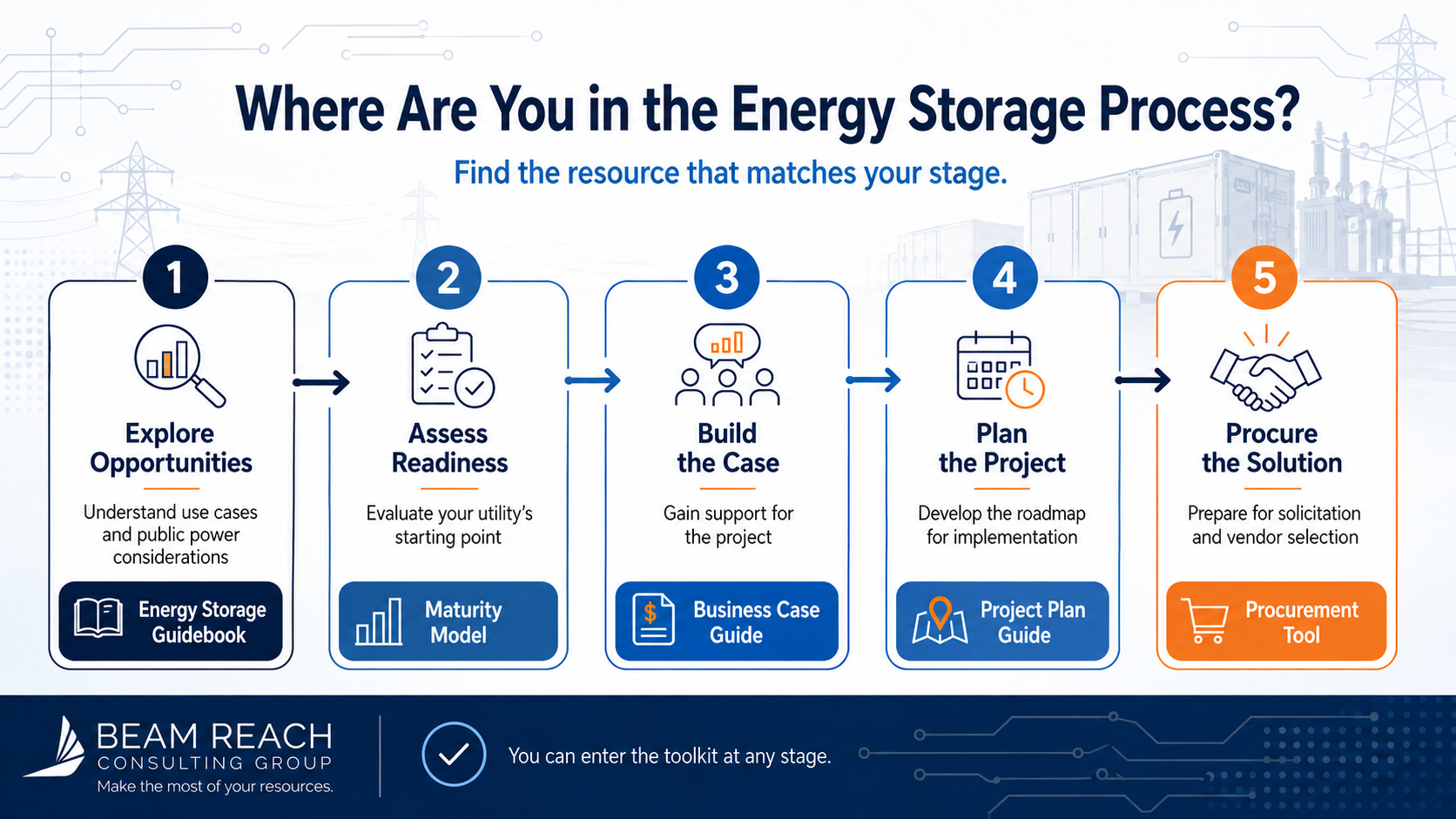
Use the toolkit from beginning to end or start with the resource that best matches your current needs.
-
The Energy Storage Guidebook provides an introduction to energy storage opportunities, applications, and considerations relevant to public power utilities.
Use the guidebook to better understand how energy storage may support priorities such as:
Peak demand management
Reliability and resilience
Renewable energy integration
Load growth and electrification
Infrastructure deferral
Cost management
Community and strategic objectives
Best for
Utilities that are beginning to explore energy storage or seeking a broader understanding of potential applications and public power considerations.
-
The Energy Storage Maturity Model helps utilities evaluate their current capabilities and determine how prepared they are to plan, procure, implement, and operate an energy storage project.
The assessment can help your organization:
Identify existing strengths
Recognize planning or organizational gaps
Establish priorities for further development
Align departments around a common understanding of readiness
Determine practical next steps
The model is not intended to determine whether a utility should pursue energy storage. Instead, it helps utilities understand what capabilities may be needed to pursue a project successfully.
Best for
Utilities that want to understand their organizational starting point before committing significant time or resources to project development.
-
The Business Case Guide helps utilities develop a clear and decision-ready rationale for an energy storage investment.
A strong business case explains why a project is needed, what alternatives were considered, what benefits and risks are expected, and why the recommended approach represents the best path forward.
The guide provides a structured but flexible framework for addressing:
The organizational or system need
Project goals and intended use cases
Alternatives considered
Proposed technical and ownership approaches
Expected costs and benefits
Financial considerations
Project risks and mitigation strategies
Implementation timelines
Measures of success
Recommended next steps
The guide is designed to support communication with utility leadership, governing boards, city officials, regulators, and other decision-makers. It is not intended to replace detailed engineering or technical analysis.
Best for
Utilities that have identified a potential energy storage opportunity and need to gain leadership, board, municipal, or regulatory support to proceed.
-
Once an energy storage project has received initial approval, the Project Plan Guide helps utility teams translate the concept into a coordinated and executable plan.
The guide is designed to help utilities move beyond a basic schedule or technical specification. It provides a structured approach for coordinating the many functions that contribute to a successful energy storage project.
Topics include:
Project objectives and charter development
Scope and success criteria
Roles, responsibilities, and governance
Technical approach and ownership structure
Site selection and permitting
Interconnection requirements
Safety and emergency response coordination
SCADA, EMS, DERMS, and IT/OT integration
Cybersecurity considerations
Procurement planning
Project timelines and critical-path activities
Stakeholder and community communication
Risk identification and management
Operational and lifecycle planning
Fillable worksheets and practical prompts help project teams document decisions, clarify responsibilities, and maintain alignment throughout project development.
Best for
Utilities that have received approval to move forward and need to coordinate engineering, operations, IT, finance, procurement, communications, leadership, and other participating functions.
-
The Procurement Guide helps utilities translate project goals and planning decisions into a clear, competitive, and defensible solicitation process.
It is designed to support the development of procurement documents that communicate utility requirements, encourage responsive proposals, and provide a sound basis for evaluating potential vendors and solutions.
The guide addresses considerations such as:
Confirming the procurement pathway
Defining the project scope
Establishing technical and performance requirements
Coordinating municipal purchasing requirements
Identifying vendor qualifications
Developing proposal instructions
Structuring evaluation criteria
Establishing scoring and review procedures
Documenting the selection process
Addressing contract, schedule, warranty, and performance risks
Preparing for project award and execution
The resource can be adapted to reflect the utility’s project objectives, governance structure, purchasing requirements, and level of internal procurement capacity.
Best for
Utilities preparing to develop a solicitation, evaluate proposals, select a vendor, or document a competitive procurement process.
