

Orchestrating Success: How High-Performing Programs Leverage Complexity
/Traditional program management often resembles a collection of skilled soloist musicians. Each organization delivers its piece to specification, yet the final result can feel disjointed; technically complete, but lacking cohesion.
The most successful programs do not eliminate complexity. They orchestrate it.

The Orchestra Conductor Model: Strategic Coordination
Conductors do not micromanage musicians. They create conditions for excellence while maintaining alignment toward a unified performance.
Advanced program management operates the same way. Rather than treating organizational dynamics, competing priorities, and stakeholder tensions as problems to resolve, effective program managers recognize stakeholder groups themselves as instruments. Leadership, technical teams, regulators, and partners each bring distinct strengths, decision frameworks, and constraints. Orchestration means aligning these differences without forcing uniformity or diluting expertise.
Leveraging Complexity
Complexity is often viewed as a liability, but in high-performing programs it becomes a capability multiplier. Simple coordination produces predictable outcomes. Complex coordination unlocks capabilities that no single organization can achieve independently.
Effective program coordination begins with a deliberate inventory of participants, their strengths, constraints, and the influence they exert on outcomes.
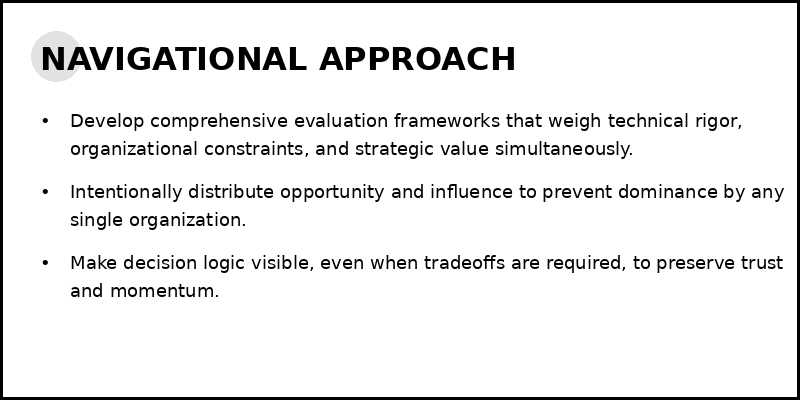
The key is intentional capability alignment. This is not ad hoc collaboration. It is deliberate design.
Jimmy Ly, a certified Project Management Professional (PMP) at Beam Reach Consulting Group, has spent years navigating multimillion-dollar initiatives where technical experience collides with organizational reality.
Ly describes it this way, "Company A excels at one capability, Company B at another, and Company C at a third. The program should be designed so each focuses on its strengths. The rest is noise.”
Competing priorities often reflect legitimate objectives, not contradiction. Different participants define excellence through different lenses. One team may prioritize speed, another safety, and another regulatory compliance. Strong program management helps participants understand why these priorities differ. That clarity makes it easier to align expectations and decisions, without forcing artificial consensus.
Ly also emphasizes the importance of knowing when to take a hands-on approach and when to take a hands-off approach. “The goal isn’t control,” Ly explains. “It’s knowing when to step in and when to let teams operate.”
Management frameworks designed for facilitation build confidence, optimize resource allocation across organizations, and enable faster decisions through distributed expertise.
In multiorganizational programs, the ability to align execution across diverse cultures becomes a distinct competitive advantage, enabling outcomes that exceed what any individual organization could accomplish alone.
Systematic Workflow Structure
The difference between programs that sustain momentum and those that stall often comes down to workflow design, the equivalent of a conductor’s score that defines when each section enters and how its contribution fits the whole.
Well-designed workflows deliver three critical coordination benefits:
· Consistent deliverables where important details do not fall through the cracks
· Enhanced coordination where the right participants have the information they need
· Operational efficiency through standardized, repeatable processes.
In combination, these benefits transform administrative complexity into a coordination advantage rather than a burden.
Ly recommends mapping out a workflow for everything you do. “When you are managing many different processes, documented workflows give you a reliable reference point,” Ly explains. “You always know the right steps to take to move work forward.”
These workflow practices serve two equally important functions: operational efficiency and stakeholder relationship management. Well-developed coordination workflows create predictable expectations, reduce emotional reactions to administrative requirements, and support consistent follow-through across diverse organizational cultures.
The Backwards-Planning Workflow Creation Process
Backward planning forces clarity, accountability, and realism before execution begins. Rather than starting with activities, effective workflow development begins with the end goal and works backward through a systematic approach. This process requires planning for two scenarios: the "happy path" where things go exactly as planned, and contingency procedures for when problems arise:
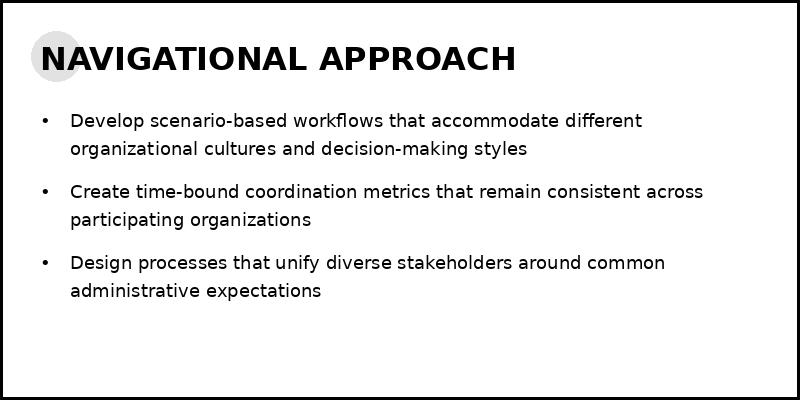
1. Define output goals - Determine exactly what will be accomplished and what success looks like.
2. Identify workflow stakeholders - Map who needs to be informed, who needs to provide input, and who has approval authority.
3. Define required tools, processes, and timing - Identify the systems, formats, and procedures required to execute the workflow, and work backward from program milestones to establish when each step must begin and what events or decisions trigger action.
4. Plan for both scenarios - Design the "happy path" plus contingency procedures for when things go wrong.
5. Build in verification and feedback loops - Include checkpoints for quality control and course correction.
The Communication Continuity Imperative
Teaming partners and other stakeholders typically balance multiple initiatives, organizations, and roles simultaneously. As a result, maintaining shared program context over long timeframes becomes difficult and, if unmanaged, destabilizing.
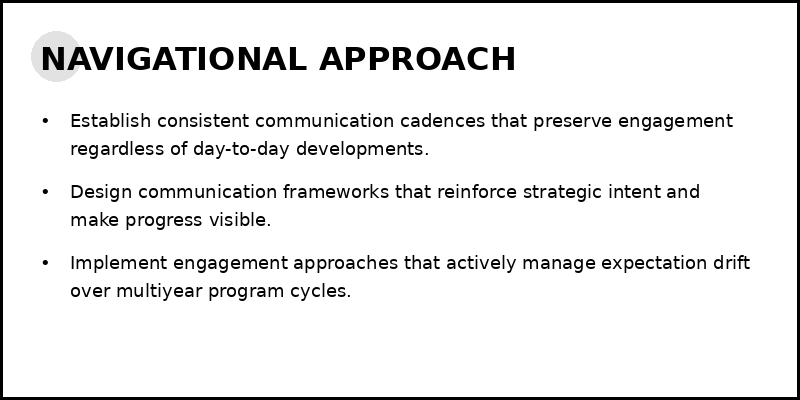
"Program momentum stalls when stakeholders lose visibility," Ly explains. "If sponsors do not understand where the work is headed or how it aligns with the original intent, confidence erodes quickly."
Effective programs address this risk through deliberate engagement approaches that reinforce context and confirm strategic alignment over time. This approach acknowledges the natural asymmetry between program teams who operate deeply within the details and stakeholders who engage intermittently across many priorities.
Rather than adding administrative burden, strong programs design engagement frameworks that sustain stakeholder awareness while enabling timely, informed decision-making throughout the program lifecycle.
Leading the Program Evolution
Program managers who master complex coordination consistently outperform those who rely on traditional simplification approaches. They deliver outcomes that exceed what any individual organization could achieve, while sustaining stakeholder confidence across long development cycles.
This orchestration mindset proves effective across diverse sectors. In energy infrastructure programs, rather than forcing uniform approaches across utilities, research institutions, and regulatory bodies, successful programs leverage each organization’s specialized capabilities while maintaining strategic coherence. Healthcare initiatives apply the same principle by combining hospitals’ patient care expertise, pharmaceutical research capabilities, and technology firms’ data analytics strengths to deliver more comprehensive treatment solutions. Manufacturing partnerships and urban development programs reflect this same pattern, aligning specialized contributors around shared outcomes.
The competitive advantage belongs to programs that embrace orchestration, recognizing that leadership is not about executing every task, but about enabling each contributor to perform at their best. Successful program managers coordinate diverse organizational capabilities to create solutions that transcend what any single participant could achieve. The result is sustained alignment, shared ownership, and outcomes that resonate across any sector requiring collaborative innovation.
The most effective program managers do not try to play every instrument. They ensure every instrument is played at its best, together.
